

That is the height a senior has to lift their leg over — on a wet surface, often without support — every time they bathe. A low threshold shower reduces that obstacle to ½ inch or less. That single change eliminates one of the most common fall scenarios in the home.
The decision to replace a standard tub with a low threshold shower is one of the most impactful home modifications an aging adult or their family can make. But it is not a one-size-fits-all decision. The right choice depends on how the person bathes today, how they are likely to bathe in five years, what the bathroom layout allows, and whether soaking is something they genuinely value.
This article walks through every dimension of the comparison — not just the safety argument, but the practical trade-offs around cost, installation complexity, daily usability, and long-term value.
The Core Problem with Standard Tubs for Seniors
Standard bathtubs were not designed with aging in mind. They were designed for a soaking experience — and the high walls that make a tub feel luxurious are exactly what make it dangerous for an older adult.
The entry sequence into a standard tub looks like this: grip the edge or wall, lift one leg over a 14–18 inch wall, shift weight to the leg inside the tub (which is now on a wet, potentially slippery surface), then lift the other leg over. On the way out, this entire sequence happens in reverse — often after the person has been in warm water, which causes blood pressure to drop and increases dizziness risk.
For a 35-year-old with full balance and strength, this is unremarkable. For a 72-year-old with reduced hip flexibility, mild balance issues, or any lower-body weakness, it is genuinely hazardous every single time.
The Centers for Disease Control and Prevention identifies falls as the leading cause of injury death among adults 65 and older. The bathroom — and specifically the tub or shower entry — is consistently identified as one of the highest-risk locations in the home. Tub-to-shower conversions are one of the most evidence-backed modifications for reducing this risk.
Why Grab Bars Alone Are Not Enough
Many families install grab bars near the tub and consider the safety problem solved. Grab bars help — but they do not eliminate the core issue, which is the height of the tub wall itself. A grab bar gives the person something to hold while they navigate a dangerous maneuver. A low threshold shower removes the dangerous maneuver entirely.
The difference is meaningful: one reduces injury when something goes wrong; the other reduces the likelihood that something goes wrong in the first place.
What "Low Threshold" Actually Means — and What It Does Not
"Low threshold shower" is a broad term, and suppliers use it inconsistently. Before you commit to a product or installation, it is worth understanding exactly what you are getting.
| Shower Type | Typical Threshold Height | What It Means in Practice |
|---|---|---|
| Standard shower with curb | 3–4 inches | Noticeable step; still requires foot lift; fall risk at entry |
| Low threshold shower | ½ to 1 inch | Minimal step; greatly reduces fall risk; easier for walkers |
| Near-flush / beveled | ¼ to ½ inch | Barely perceptible step; works for most mobility needs |
| Zero-entry / barrier-free | Flush (0 inches) | No step at all; wheelchair accessible; requires subfloor modification |
When a supplier says "low threshold," ask for the specific measurement. A 1-inch threshold and a ½-inch threshold are both technically "low" — but for someone with a walker or significant balance issues, that half-inch difference can still matter. A threshold of ½ inch or less is the target for meaningful fall risk reduction.
If you are planning for long-term aging in place, or if wheelchair access is a possibility in the future, a zero-entry or barrier-free roll-in shower is worth the additional investment — it eliminates the threshold entirely and future-proofs the bathroom against changing mobility needs.
Low Threshold Shower vs Standard Tub: Head-to-Head Comparison
| Factor | Low Threshold Shower | Standard Bathtub |
|---|---|---|
| Entry difficulty for seniors | Very low — minimal or no step | High — 14–18" wall lift required |
| Fall risk at entry | Significantly reduced | High — most common fall scenario |
| Walker / wheelchair compatible | Yes, at ½" threshold or lower | No |
| Caregiver assistance | Much easier — open access | Difficult — enclosed space, high walls |
| Daily routine speed | Fast — in and out in minutes | Slower — fill, soak, drain |
| Soaking / hydrotherapy | Not applicable | Yes — therapeutic benefit for joint pain |
| Cleaning and maintenance | Easier — fewer surfaces, no grout required | More demanding — large surface area, caulk lines |
| Home resale value | Neutral to positive — modern look | Neutral — buyers vary on tub preference |
| Installation complexity | Moderate — tub-to-shower conversion | Low — replacement only |
| Long-term adaptability | High — can add bars, seat, upgrade threshold | Limited — fundamental design is fixed |
When a Low Threshold Shower Is the Right Choice
A low threshold shower is the right choice for most seniors who are doing this evaluation. Here are the specific situations where it is clearly the better fit:
Balance concerns or reduced hip flexibility
Eliminating the tub wall removes the primary fall risk. Even a ½-inch bevel is dramatically safer than a standard curb.
Daily independence is the priority
Showers are faster, require less energy, and are easier to manage without assistance than a tub soak.
A caregiver assists with bathing
Open shower entries give the caregiver room to assist safely, without the awkward positioning a tub requires.
Walker or mobility device use
A low threshold at ½ inch allows most walkers to roll up to the entry. A zero-entry shower accommodates wheelchairs fully.
When Keeping a Tub (or Adding a Walk-In Tub) Still Makes Sense
There are genuine cases where a tub — specifically a walk-in tub — remains the better choice. The key question is whether soaking plays a meaningful role in the person's comfort and routine.
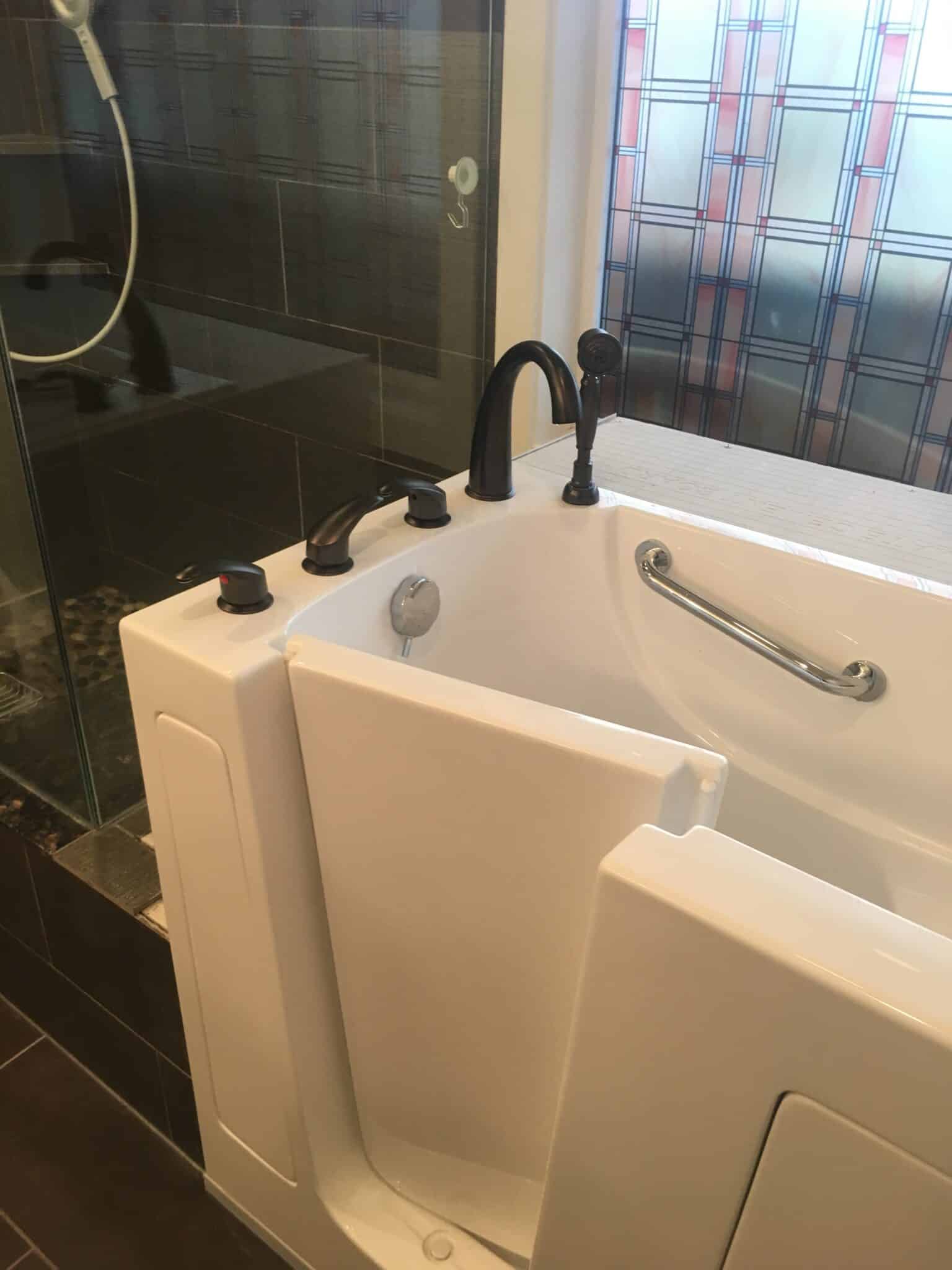
Seniors with chronic joint pain, arthritis, fibromyalgia, or muscle stiffness often find that warm water immersion provides real therapeutic relief. A standard tub is dangerous for them — but a walk-in tub, which has a door built into the side so you enter and then fill the tub, can provide the soaking benefit without the dangerous step-over entry.
Walk-in tubs have their own trade-offs: the person must be seated inside the tub while it fills and while it drains, which takes time and patience. They are not practical for a quick daily shower routine. Many families who install walk-in tubs also convert a second bathroom to a roll-in or low threshold shower for daily use — using the tub for therapeutic soaks a few times a week.
What a Tub-to-Low-Threshold-Shower Conversion Actually Involves
Many homeowners hesitate at the idea of removing a tub because they assume it requires a major renovation. In most cases, a tub-to-shower conversion is more straightforward than it sounds — particularly when working within the existing tub alcove footprint.
The Typical Conversion Process
- Tub and surround removal: the existing tub and tile or surround panels are removed, along with the tub drain.
- Subfloor assessment: the subfloor is inspected for moisture damage or rot — common in older bathrooms. Any damaged material is replaced at this stage.
- Shower pan installation: a new low threshold or near-flush shower pan is set and leveled. For zero-entry builds, the subfloor may need to be lowered to achieve a flush transition.
- Drain connection: the new drain is connected to the existing plumbing, or relocated depending on the pan design and drain style chosen.
- Wall system installation: wall panels or tile are installed over a properly waterproofed backer. This is where the watertight seal is established.
- Fixtures and accessories: showerhead, controls, grab bars, and seat are installed. Blocking for grab bars should be confirmed before walls are closed.
With an experienced installer and a prefabricated shower system, this entire process can be completed in a single day in most standard alcove bathrooms. Our White Glove Installation service is specifically designed for one-day accessible shower builds — factory certified installers, proper subfloor assessment, and blocking installed throughout.
Key Features to Include in Your Low Threshold Shower
Choosing the right threshold height is the foundation — but the features you add around it determine how safe and comfortable the shower is in daily use. Do not treat these as optional upgrades. They are part of what makes the investment worthwhile.
- Slip-resistant pan surface — wet COF of 0.6 or higher. Do not assume any shower pan meets this standard; confirm it.
- Entry grab bar — a vertical bar at the entry edge, reachable before stepping in. This is the support point most commonly missing.
- Fold-down seat — even for seniors who do not currently need to sit. Fatigue is unpredictable, and having the option available is far cheaper than adding it later.
- Handheld showerhead on slide bar — allows use from seated height and gives caregiver flexibility. One of the highest-value additions for any senior shower.
- Thermostatic mixing valve — prevents accidental scalding if hot water pressure fluctuates. Especially important for seniors with reduced temperature sensitivity.
- Structural blocking throughout walls — installed during build so grab bars can be added anywhere in the future without opening the wall.
- Reachable controls — positioned so water can be started and temperature set before the person steps into the spray zone.
When making feature decisions, ask: what will this person need in five years, not just today? A fold-down seat, blocking for future grab bars, and a near-flush threshold cost relatively little extra when included in the original build. Adding them later — especially the blocking — can require opening walls and a second renovation. Plan once, build for the range of possible needs.
Cost: What to Expect for a Tub-to-Shower Conversion
Cost is often the biggest concern — and the widest range of answers you will find online reflects how much variation there is based on location, bathroom condition, product selection, and scope. Here is a realistic framework for understanding what drives cost.
| Cost Factor | Lower End | Higher End |
|---|---|---|
| Shower pan (low threshold) | Standard acrylic, prefab | Solid surface, custom tile-ready, or barrier-free |
| Wall system | Prefabricated acrylic panels | Tileable backer with custom tile installation |
| Subfloor condition | Clean and dry — minimal prep | Moisture damage or rot requiring replacement |
| Drain type | Center drain, existing location | Linear / trench drain, relocated plumbing |
| Accessibility features | Basic grab bar and seat | Full blocking, fold-down seat, thermostatic valve, slide bar |
| Installation | One-day prefab system | Custom build with tile, multiple trades |
The most cost-effective path for most families is a prefabricated shower system with a low threshold or near-flush pan, installed professionally in a single day. This avoids the cost and disruption of custom tile work while delivering a durable, accessible, and good-looking result.
If budget is a concern, prioritize the threshold height, the slip-resistant pan, and blocking for future grab bars. The seat and handheld head can be added later. The subfloor and threshold design cannot — at least not without a second renovation.
Veterans should also ask about the VA HISA Grant for Bathroom Modifications, which can cover part or all of an accessible bathing upgrade for qualifying veterans.
Can I keep a tub and also add a low threshold shower?
Yes, if your bathroom layout and budget support it. Some homes have two bathrooms — a primary with a tub and a secondary with a shower — and converting the secondary bathroom to a low threshold shower gives the senior a safer daily option without removing the tub entirely. In a single-bathroom home, the choice is usually either-or. If soaking is genuinely important, a walk-in tub may be a better replacement for the standard tub than a standard tub-to-shower conversion.
Will replacing my tub hurt my home's resale value?
This concern comes up often, and the short answer is: it depends on the home and the market. In multi-bathroom homes, removing one tub rarely affects resale significantly — particularly if the conversion is done with quality materials and looks modern. In a single-bathroom home, some buyers prefer a tub, so this is a more meaningful trade-off. That said, for a senior who is aging in place with no near-term plans to sell, the safety benefit of a low threshold shower outweighs the speculative resale concern in most cases.
What is the difference between a low threshold shower and a walk-in shower?
The terms are often used interchangeably, but there is a distinction worth knowing. A "walk-in shower" typically refers to any shower without a door — the entry is open, and water is contained by the layout of the space and the slope of the floor. A "low threshold shower" specifically refers to the height of the entry curb. A shower can be low threshold and have a door, or it can be a fully open walk-in design. For seniors, the most important factor is the threshold height — whether or not there is a door is a secondary consideration. Read our full guide on choosing a roll-in shower for elderly adults for more detail.
How long does a tub-to-shower conversion take?
With a prefabricated shower system and an experienced installer, most standard alcove tub-to-shower conversions are completed in a single day. Custom tile builds typically take 2–4 days, depending on the scope and drying time required for mortar and grout. Our White Glove Installation service is specifically designed for one-day completion on prefabricated systems — minimizing disruption to the household.
Can I install grab bars after the shower is built?
You can, but it is significantly more difficult and expensive if the walls do not have blocking (structural backing) already installed behind them. Grab bars mounted into drywall or tile alone cannot safely support the load they are designed for. If blocking was not installed during the original build, adding grab bars later typically requires opening the wall, installing the blocking, and re-tiling or re-paneling that section. This is one of the strongest arguments for installing blocking throughout the shower walls during the original conversion — it adds little cost upfront and avoids a much larger cost later.
Is a low threshold shower the same as an ADA shower?
Not exactly. ADA (Americans with Disabilities Act) standards set specific requirements for shower dimensions, grab bar height, seat height, controls placement, floor slope, and more. A low threshold shower may meet some but not all ADA requirements depending on its design. If meeting full ADA standards is the goal — for wheelchair access, for a household that receives home care, or for future-proofing — it is worth specifically asking whether the shower design meets ADA specifications. Read more in our guide on ADA roll-in showers and fall prevention.
What should I do first if I am just starting this process?
Start with three things: measure the existing tub space (width × depth, wall to wall), identify whether there is a second bathroom in the home, and think through the person's daily bathing routine — do they currently sit, stand, or rely on assistance? Those three inputs will shape every decision that follows. Then request a consultation so you can see what options are realistic for your space and budget. You can get a free consultation here or call us at 1-888-779-2284.
The Bottom Line
For most seniors, replacing a standard tub with a low threshold shower is one of the best home modifications available — not just for safety, but for daily confidence and independence. The tub wall that seemed unremarkable at 40 becomes a genuine hazard at 70, and the cost of not addressing it can be far greater than the cost of the renovation.
The key decisions are threshold height (aim for ½ inch or less), floor traction (slip-resistant surface, not just a bath mat), and features that match the person's routine — particularly seating and grab bar placement. If long-term aging in place is the goal, plan for a near-flush or zero-entry design from the start, even if the person does not currently need wheelchair access.
The shower you build today should still be the right shower in ten years. That is the standard worth planning to.
Standard tubs are one of the highest fall-risk fixtures in a senior's home. Low threshold showers — particularly at ½ inch or less — dramatically reduce that risk while supporting daily independence, caregiver assistance, and future mobility needs. Include a slip-resistant pan, entry grab bar, fold-down seat, handheld showerhead, and structural blocking in your initial build. If soaking is a priority, compare walk-in tub options before committing. And if long-term aging in place is the goal, consider a zero-entry or barrier-free design from the start.
Ready to Replace Your Tub? Let's Find the Right Setup.
We help seniors and families compare low threshold showers, roll-in designs, and walk-in tubs — based on your bathroom, your routine, and your budget. Free consultation, no pressure.
Get a Free Quote & Consultation → Or call us: 1-888-779-2284 (BATH)